For many Christians, the concept of Church authority can feel confusing or even unnecessary. Some assume it developed centuries later as the Church became more organized. But when we examine the New Testament as well as the oldest Christian writings closely, we find something different. The first Christians believed that the mission Jesus gave the apostles was intended to continue after them.
This is where the idea of apostolic succession explained simply starts. Catholics believe that the authority Jesus granted to the apostles was not intended to die with them. Instead, it was entrusted to new leaders who would guide the Church, defend its teaching, and carry on the work that the apostles began.
Understanding this idea helps explain why bishops matter in the life of the Church, and why the succession of the apostles has been such an important part of Christian history from the very beginning.
What Apostolic Succession Is
For many Christians, the term apostolic succession may sound technical or complicated. But the basic idea is actually very easy. Once you understand it, it helps explain why Catholics care about bishops and how the authority of the Church is believed to continue through history.
A Simple Definition
Put simply, apostolic succession means this: The mission and authority that Jesus gave the apostles did not die when the apostles died. Instead, it was passed on to other leaders who continued to guide the Church.
In the early Christian communities, these successors became known as Bishops. They had been trusted with the responsibility of teaching the faith, maintaining unity, and caring for the local Church.
This is what Catholics refer to as the succession of the apostles. The leadership of the Church did not begin afresh in every generation. It was carried on through an unbroken line of bishops, which extended back to the earliest communities of Christians founded by the apostles themselves.
The Basic Idea in One Sentence
If we had to sum up apostolic succession as simply as possible, it would look like this:
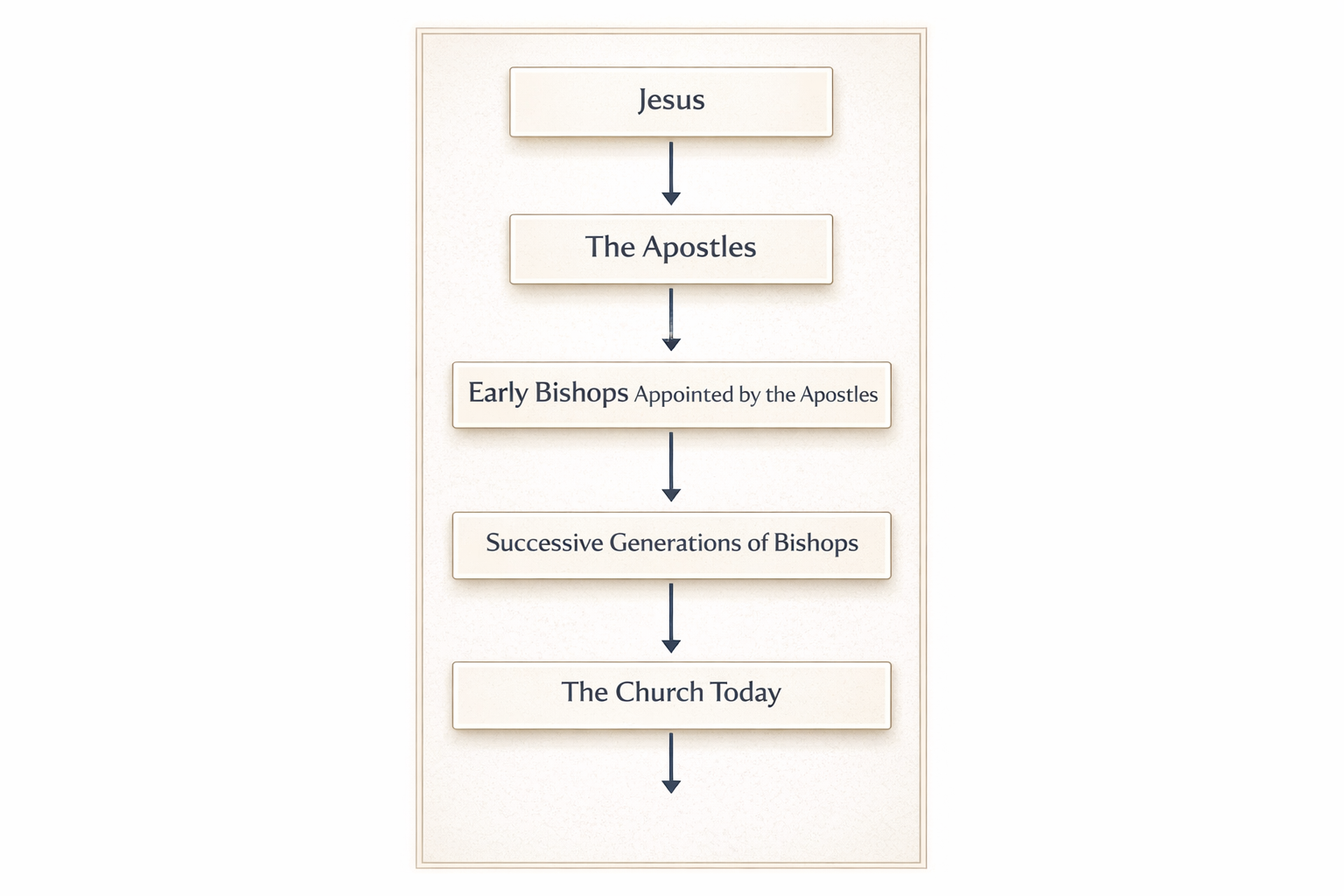
- Jesus sends the apostles.
- The apostles appoint new leaders.
- Those leaders carry on the mission of the Church.
This pattern is found throughout the New Testament and the history of the early Church. The apostles did not regard their mission as something that would end with them. They actively entrusted leadership to others who would carry it forward.
A Simple Way to Visualize It
Sometimes it helps to picture the idea as a chain that continues through history:
Biblical Foundations for Apostolic Succession
For Catholics, the concept of apostolic succession is not tied solely to later church history. The roots of the idea can be found directly in the New Testament itself. When we read carefully, we can see that the apostles expected their mission to continue and took concrete steps to pass leadership on to others.
These passages also help explain why bishops matter in the life of the Church, and how the authority of the Church was understood in the earliest Christian communities.
Leadership Passed On in the Early Church
One of the clearest examples appears at the very beginning of the Church in Acts 1:20–26.
After Judas Iscariot’s death, the apostles did not just leave his place empty. Instead, they gathered together and decided to choose a replacement so that the apostolic ministry would not be incomplete. Peter explains this by quoting the Psalms and saying:
“Let another take his office.”
— Acts 1:20
The apostles then prayed and chose Matthias to replace Judas among the Twelve.
This moment is significant. The apostles clearly understood their role as not merely a personal mission, but as an office that could be filled by another person. Even before the Church began to spread widely, leadership was already being passed on so that the work that Christ gave the apostles would continue.
The Laying On of Hands
Another important pattern in the New Testament is the laying on of hands, a visible act used to entrust someone with ministry.
Paul reminds Timothy about this in 1 Timothy 4:14, writing:
“Do not neglect the gift you have, which was given you by prophecy when the council of elders laid their hands on you.”
Later, Paul refers to the same moment again in 2 Timothy 1:6:
“I remind you to fan into flame the gift of God, which is in you through the laying on of my hands.”
These passages reveal that leadership in the early Church was not something that people just claimed for themselves. Responsibility and ministry were publicly entrusted and recognized. The laying on of hands was a visible sign that someone had been assigned a role within the leadership of the Church.
This practice later became central to the way bishops and other ministers were ordained, helping to preserve the continuity of leadership and the authority of the Church across generations.
Paul Entrusting Leadership to Others
The New Testament also shows a clear pattern of leadership being passed from one generation to the next.
In 2 Timothy 2:2, Paul gives Timothy this instruction:
“What you have heard from me before many witnesses entrust to faithful men who will be able to teach others also.”
Notice the chain that appears in this one verse:
- Paul teaches Timothy
- Timothy hands the teaching over to others
- Those leaders continue to teach future believers
In other words, the Christian message was intended to be passed on through reliable leaders who could teach and guide the community.
This pattern helps us understand why the early Church cared so much about leadership and continuity. It also sheds light on why the bishops were considered important in preserving the teaching of the apostles and the unity and authority of the Church through the years.
Why Apostolic Succession Matters
It is one thing to understand what apostolic succession is. A more interesting question is why it matters at all.
Why did early Christians care so much about who led the Church? Why were bishops considered important? When we look at the history of the early Church, the answer becomes clearer. Leadership was not just about organization. It was about protecting the faith and keeping the Christian community united.
Protecting the Teaching of the Church
From the very beginning, Christians were concerned about preserving the message they had received from the apostles. Even the New Testament shows that confusion and false teachings appeared early.
Because of this, leadership mattered. Bishops were responsible for teaching the faith and helping ensure that what Christians believed remained consistent with the apostolic message.
In other words, the role of bishops was not simply administrative. Part of why bishops matter is that they helped guard the core teaching of the Church as Christianity spread into new cultures and communities.
Preserving Unity
As Christianity grew, churches began appearing in cities across the Roman world. These communities were often far apart from one another, yet they shared the same faith.
Bishops helped make that unity visible. They served as leaders of local churches while remaining connected to other bishops and Christian communities. This shared leadership helped maintain a sense that the Church was one body, even though it existed in many different places.
Without that kind of leadership, it would have been much easier for communities to drift in completely different directions.
Safeguarding the Sacraments
Apostolic succession is also closely connected to the sacramental life of the Church.
In Catholic teaching, bishops are responsible for overseeing the life of the Church in their communities, including the celebration of the sacraments. Priests assist in this mission, but bishops hold the responsibility of ensuring that the sacramental life of the Church continues in continuity with the apostles.
This connection helps explain why the authority of the Church is tied to apostolic leadership. The goal is not control, but continuity with the mission Christ first gave to the apostles.
Staying Connected to the Early Church
Another reason apostolic succession matters is that it connects the Church today with the earliest generations of Christians.
The bishops leading Christian communities today did not appear out of nowhere. Their leadership exists within a long historical line that stretches back through centuries of Christian history.
For many believers, this continuity raises an interesting thought. The Church today is not simply a modern institution. In many ways, it sees itself as part of the same story that began with Jesus and the apostles.
Clarifying the Role of Church Authority
Finally, apostolic succession helps explain how Catholics understand the authority of the Church.
This authority is not meant to replace Scripture or stand above it. Instead, it serves the role of preserving the teaching that the apostles received and handed on. Bishops are understood as stewards of that teaching, responsible for guiding the Church and protecting its unity.
Seen in this light, apostolic succession is less about power or hierarchy and more about continuity, responsibility, and faithful stewardship of the apostolic mission.
Common Protestant Concerns
When people first hear about apostolic succession, it often raises some natural questions. For many Protestants especially, the idea of Church authority can sound unfamiliar or even unnecessary. But many of these concerns become clearer when we look at how leadership actually worked in the early Church.
“Does This Replace Scripture?”
One of the most common worries is that apostolic succession might place Church authority above the Bible. But that is not how Catholics understand it.
Scripture remains at the heart of Christian faith and teaching. In fact, the role of bishops has traditionally been to teach and preserve what Scripture says, not replace it. Their responsibility is to help ensure that the message of the apostles continues to be taught faithfully as the Church grows and spreads.
In that sense, succession is meant to protect the faithful teaching of Scripture, not compete with it.
“Isn’t This Just Institutional Authority?”
Another concern is that apostolic succession might simply be about building a religious institution with layers of authority.
But when we read early Christian writings, leadership looks much less like bureaucracy and much more like responsibility and service. Bishops were expected to care for their communities, teach the faith clearly, and help preserve unity among believers.
Writers like Ignatius of Antioch in the early second century already encouraged Christians to remain united around their bishop, not because of power, but because it helped keep the Church connected and faithful to its teaching.
“Why Bishops at All?”
Some Christians today are used to the idea that each church operates independently. But the earliest Christian communities usually saw themselves as part of a larger Church.
Bishops helped make that unity visible. They guided local communities while also staying connected with other Christian leaders. This helped ensure that the same faith was being taught across different regions.
Understanding this historical context helps explain why bishops matter in the Catholic view of the Church.
“What About Bad Bishops?”
Another honest question people ask is this: what happens when church leaders fail?
History shows that Christian leaders, like all people, can make mistakes or fall short. Apostolic succession does not mean every bishop will be perfect.
Instead, the idea is that the authority of the Church is part of a larger structure meant to preserve the faith over time. Even when individual leaders fail, the mission of the Church and the teaching handed down from the apostles continues.
What the Earliest Christians Said About Church Leadership
The New Testament gives us the beginnings of leadership being passed on in the Church. But if we want to see how those ideas actually played out, it helps to look at the generation of Christians who lived immediately after the apostles.
When we read their writings, we find something interesting. These early Christians already spoke about bishops and church leadership in ways that sound very familiar to the idea of the succession of the apostles.
One of the earliest examples comes from Clement of Rome, writing around AD 96. Clement was a leader in the Church at Rome and likely knew some of the apostles or their close companions. In a letter to the Christians in Corinth, he explained that the apostles did not simply preach the gospel and leave communities to organize themselves.
According to Clement, the apostles intentionally appointed leaders to guide the Church after them. He writes:
“Our apostles knew through our Lord Jesus Christ that there would be strife over the office of bishop. For this reason, therefore, having received perfect foreknowledge, they appointed those already mentioned and afterwards added the further provision that, if they should die, other approved men should succeed them in their ministry.”
— Clement of Rome, First Letter to the Corinthians, ch. 44
This passage is remarkable because it shows that the idea of leadership continuing after the apostles was already expected in the first century.
A few years later, another early Christian leader, Ignatius of Antioch, wrote a series of letters while traveling to Rome for martyrdom around AD 107. In these letters he repeatedly emphasized the role of bishops in the life of the Church.
Ignatius encouraged Christians to remain united with their bishop, seeing this leadership as essential for maintaining unity and faithful teaching. In one letter he wrote:
“See that you all follow the bishop, even as Jesus Christ follows the Father.”
— Ignatius of Antioch, Letter to the Smyrnaeans, ch. 8
Ignatius was not introducing a new system of leadership. His letters assume that Christian communities already understood the importance of bishops and their role in guiding the Church.
When we read these early sources together, a pattern emerges. The apostles preached the gospel and founded Christian communities. Those communities were then led by bishops and other ministers who continued teaching and guiding the faithful.
Listen and Ask Questions on Catholic Answers Live
If learning about apostolic succession raises questions for you, that is a good thing. Many people discover that looking at Scripture and early Christian history opens up new questions about leadership in the Church, the role of bishops, and how the Christian faith has been handed on over time.
If you would like to explore those questions further, we invite you to join Catholic Answers Live, airing weekdays from 5 to 7 PM on St. Michael Catholic Radio in Tulsa. It is a national call-in program where listeners bring thoughtful questions about topics like Church authority, Scripture, history, and the Christian faith.
Maybe you are wondering why bishops matter, how apostolic succession works, or what the authority of the Church really means. Whatever your question is, you are welcome to call in. The goal is respectful conversation, honest questions, and deeper understanding.
FAQs
Is apostolic succession in the Bible?
The term itself isn’t used, but the idea is there. The apostles replaced Judas, laid hands on new leaders, and passed their teaching on to others.
Doesn’t this create man made authority?
Catholics believe the authority comes from Christ. The apostles were given leadership, and they passed that responsibility on so the Church could continue its mission.
What about bad bishops?
Like any leaders, bishops are human and can fail. Apostolic succession doesn’t mean every bishop is perfect, but that the Church’s mission continues through time.