Everything needed to follow along, including the prayers written out in full, is here. The broadcast airs live on 94.9 FM Tulsa and is available to stream anytime online.
What the Rosary Is
A Prayer Centered on Christ
The Rosary is a meditative prayer that moves through scenes from the life of Christ, organized into groups of five called decades. Each decade focuses on a different moment: the Annunciation, the Crucifixion, the Resurrection, and so on. The prayers said on the beads, primarily the Hail Mary, form a kind of rhythmic backdrop while the mind rests on that scene and meditates on what it means.
It is worth being clear about this from the start: the Rosary is not a prayer to Mary in the sense of directing worship toward her. It is a meditation on Christ’s life, held in the context of Mary’s presence within that story. The Hail Mary asks for her intercession, the same way a Catholic might ask any saint to pray for them. The focus of the mysteries is Christ: his birth, his teaching, his suffering, his resurrection, and his glory. Mary is present throughout, as she was in the events being recalled, but the subject of the prayer is her son.
What You Need
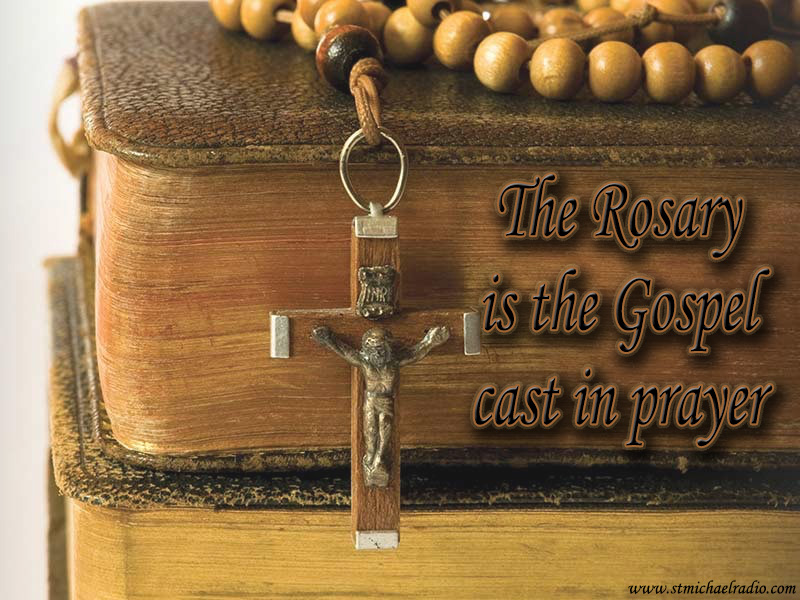
A set of rosary beads is the most practical tool, but it is not strictly required. A person can pray the Rosary by counting decades on their fingers. The beads exist as a tactile aid that keeps track of where a person is in the prayer without requiring them to count consciously. For a first-time listener, having beads in hand while following along with the broadcast makes it easier to follow the structure.
The Prayers of the Rosary
Written Out in Full
These are the prayers used throughout the Rosary. A person who knows these prayers knows everything they need to pray the whole thing.
The Apostles’ Creed (said at the beginning, holding the crucifix):
I believe in God, the Father almighty, Creator of heaven and earth, and in Jesus Christ, his only Son, our Lord, who was conceived by the Holy Spirit, born of the Virgin Mary, suffered under Pontius Pilate, was crucified, died and was buried; he descended into hell; on the third day he rose again from the dead; he ascended into heaven, and is seated at the right hand of God the Father almighty; from there he will come to judge the living and the dead. I believe in the Holy Spirit, the holy catholic Church, the communion of saints, the forgiveness of sins, the resurrection of the body, and life everlasting. Amen.
The Our Father (said on each large bead):
Our Father, who art in heaven, hallowed be thy name; thy kingdom come; thy will be done on earth as it is in heaven. Give us this day our daily bread; and forgive us our trespasses as we forgive those who trespass against us; and lead us not into temptation, but deliver us from evil. Amen.
The Hail Mary (said on each small bead, ten times per decade):
Hail Mary, full of grace, the Lord is with thee; blessed art thou among women, and blessed is the fruit of thy womb, Jesus. Holy Mary, Mother of God, pray for us sinners, now and at the hour of our death. Amen.
The Glory Be (said after each decade):
Glory be to the Father, and to the Son, and to the Holy Spirit; as it was in the beginning, is now, and ever shall be, world without end. Amen.
The Fatima Prayer (said after each Glory Be):
O my Jesus, forgive us our sins, save us from the fires of hell, lead all souls to heaven, especially those in most need of thy mercy.
The Hail Holy Queen (said at the end of the five decades):
Hail, Holy Queen, Mother of Mercy, our life, our sweetness and our hope. To thee do we cry, poor banished children of Eve. To thee do we send up our sighs, mourning and weeping in this valley of tears. Turn then, most gracious advocate, thine eyes of mercy toward us; and after this our exile, show unto us the blessed fruit of thy womb, Jesus. O clement, O loving, O sweet Virgin Mary.
The Four Sets of Mysteries
What Is Meditated On
Each decade of the Rosary is prayed while holding a specific mystery in mind. The mysteries are organized into four sets, traditionally prayed on different days of the week.
The Joyful Mysteries (Monday and Saturday): The Annunciation, The Visitation, The Nativity, The Presentation in the Temple, The Finding of Jesus in the Temple.
The Luminous Mysteries (Thursday, added by Pope John Paul II in 2002): The Baptism of Jesus in the Jordan, The Wedding Feast at Cana, The Proclamation of the Kingdom, The Transfiguration, The Institution of the Eucharist.
The Sorrowful Mysteries (Tuesday and Friday): The Agony in the Garden, The Scourging at the Pillar, The Crowning with Thorns, The Carrying of the Cross, The Crucifixion and Death of Jesus.
The Glorious Mysteries (Wednesday and Sunday): The Resurrection, The Ascension, The Descent of the Holy Spirit at Pentecost, The Assumption of Mary, The Coronation of Mary.
A Note on the Mysteries
Beginners do not need to meditate deeply on the mystery during every Hail Mary. Simply holding the name of the mystery in mind while praying is enough. The meditative depth comes with practice and is not a requirement for the prayer to be complete.
Step-by-Step: How to Pray One Decade
Here is the full pattern for a single decade, which can be repeated for each of the five decades in a complete Rosary:
- Announce the mystery for that decade. Say its name aloud or hold it in mind.
- On the large bead: say the Our Father.
- On each of the ten small beads: say the Hail Mary. Ten Hail Marys per decade.
- After the tenth small bead: say the Glory Be.
- Then say the Fatima Prayer.
- Move to the next large bead and begin the next decade.
To pray the full Rosary, begin with the Sign of the Cross, then the Apostles’ Creed (on the crucifix), then an Our Father, three Hail Marys, and a Glory Be on the introductory beads before the first decade. After the fifth decade, close with the Hail Holy Queen.
Following Along on St. Michael Radio
The Rosary at 8 AM on 94.9 FM
The Rosary with Bishop Robert Barron airs every weekday at 8 AM on Catholic radio on 94.9 FM Tulsa. For anyone who wants to learn the Rosary by listening rather than reading, following the broadcast with a set of beads in hand is one of the most effective ways to do it. The prayers become familiar quickly when heard regularly at the same hour.
The broadcast is also available through the live stream at stmichaelsradio.com/listen for those who prefer to follow along on a phone or computer. After the Rosary, the full day’s programming continues across the weekday schedule. For those who want to explore other devotional content after the Rosary, the Divine Mercy Chaplet airs later the same day at 3 PM, also on 94.9 FM and on the stream.
Starting With One Decade
For those who find the full twenty-minute Rosary daunting at first, there is nothing wrong with beginning with one decade. One Our Father, ten Hail Marys, a Glory Be, and a Fatima Prayer takes about three to four minutes. Most people who begin with one decade find themselves adding more over time, not because they feel obligated to but because the rhythm of it becomes its own kind of rest. The full Rosary tends to arrive naturally once the single decade is familiar.
Sources
- Prayer texts are the traditional Catholic forms in common use.
- The Luminous Mysteries were added by Pope John Paul II in the apostolic letter Rosarium Virginis Mariae (2002).
- Program schedule sourced from stmichaelsradio.com/programs (captured June 2026).
12 Flashcard Q&As
Q1: What is the Rosary? A: A meditative Catholic prayer structured around five decades, each focused on a mystery from the life of Christ. The Hail Mary is prayed ten times per decade while the mind meditates on that mystery.
Q2: How long does it take to pray the Rosary? A: Approximately 20 minutes for a full five-decade Rosary. One decade takes about 3 to 4 minutes, which is a manageable starting point for beginners.
Q3: How many sets of mysteries are there? A: Four: the Joyful Mysteries (Monday and Saturday), the Luminous Mysteries (Thursday), the Sorrowful Mysteries (Tuesday and Friday), and the Glorious Mysteries (Wednesday and Sunday).
Q4: What prayers are said during the Rosary? A: The Apostles’ Creed, the Our Father, the Hail Mary, the Glory Be, the Fatima Prayer, and the Hail Holy Queen. All are written out in full in this article.
Q5: What is the Fatima Prayer? A: A short prayer said after each decade: “O my Jesus, forgive us our sins, save us from the fires of hell, lead all souls to heaven, especially those in most need of thy mercy.”
Q6: Do I need rosary beads to pray the Rosary? A: No. Beads help keep track of where you are in the prayer, but a person can count decades on their fingers. Beads are a practical aid, not a requirement.
Q7: Who added the Luminous Mysteries? A: Pope John Paul II, in his 2002 apostolic letter Rosarium Virginis Mariae. Before 2002, the Rosary had only three sets of mysteries.
Q8: What are the Joyful Mysteries? A: The Annunciation, the Visitation, the Nativity, the Presentation in the Temple, and the Finding of Jesus in the Temple. They are traditionally prayed on Mondays and Saturdays.
Q9: What are the Sorrowful Mysteries? A: The Agony in the Garden, the Scourging at the Pillar, the Crowning with Thorns, the Carrying of the Cross, and the Crucifixion. They are traditionally prayed on Tuesdays and Fridays.
Q10: Can I pray the Rosary without knowing the mysteries well? A: Yes. Simply holding the name of the mystery in mind while praying is sufficient. Deeper meditation on each mystery develops naturally with practice and is not required for the prayer to be complete.
Q11: When does the Rosary air on St. Michael Catholic Radio? A: Every weekday at 8:00 AM on 94.9 FM Tulsa, with Bishop Robert Barron. It is also available through the live stream at stmichaelsradio.com/listen.
Q12: Is the Rosary only for experienced Catholics? A: No. The prayers are simple and repetitive, which makes them easy to learn. Many people pray the Rosary for years before fully understanding all of its theology. The prayer itself is accessible from the first attempt.