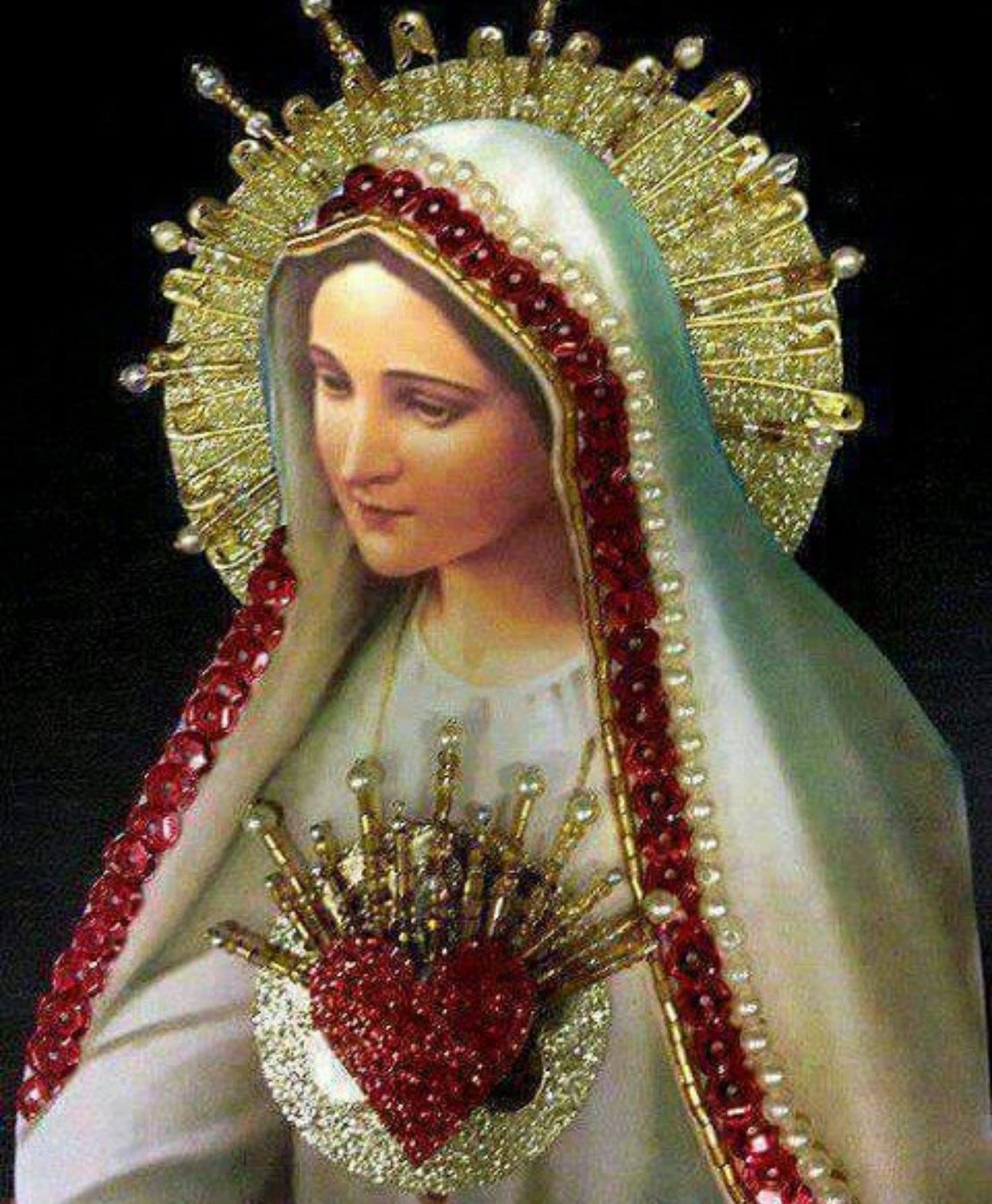
The Catholic Church’s answer to those questions is careful and consistent: Catholics honor Mary, but they do not worship her. What they believe about her is rooted in what they believe about her son. Catholic Answers Live addresses questions about Mary regularly on its weekday broadcast at 5 PM on 94.9 FM Tulsa, and the station is available to stream anytime online.
The Key Distinction: Veneration and Worship
Catholic theology has long distinguished between worship and veneration, two different things. Worship, which the tradition calls latria, belongs to God alone. It is the adoration owed only to the divine. Veneration, which the tradition calls dulia, is a different category: honor given to a person because of their holiness or their closeness to God. Catholics give ordinary veneration to the saints and a higher form of veneration, called hyperdulia, to Mary. Neither is worship.
This distinction is not a modern invention. It was articulated clearly by theologians like John of Damascus in the eighth century and Thomas Aquinas in the thirteenth. The Second Council of Nicaea in 787 AD formally addressed it in the context of images and icons. The consistent Catholic position across the centuries is that what is given to Mary is honor, not adoration, and that adoration belongs to God alone.
Why Mary Holds the Place She Does
The honor Catholics give to Mary flows directly from who she is in relation to Christ. She is the mother of the one Catholics believe to be God incarnate. That relationship does not make her divine. It does make her unique among all human beings who have ever lived, and it gives her a unique place in the story of salvation. Catholic veneration of Mary is not a diversion from faith in Christ. It is, instead, a consequence of it.
The Four Marian Dogmas
Mother of God (Theotokos)
The oldest formally defined Marian teaching is not primarily about Mary at all. When the Council of Ephesus in 431 AD declared Mary to be Theotokos, the Greek word meaning God-bearer or Mother of God, it was making a statement about Christ. To say that Mary is the Mother of God is to say that the child she bore is genuinely God: the divine and human natures in Christ are united in one person from the moment of his conception, not joined together later. Denying the title would have implied that Mary bore only the human nature of Christ, which would have introduced a separation in Christ that orthodox Christianity rejected.
The title Theotokos was already in widespread use in Christian prayer and writing before the Council of Ephesus. Its formal definition was, therefore, the Church’s response to a theological dispute about the nature of Christ, not a new elevation of Mary.
Immaculate Conception
This teaching is frequently confused with the Virgin Birth of Jesus, which is a different doctrine. The Immaculate Conception refers to Mary herself: the Church teaches that she was conceived without original sin, preserved from it by a special grace of God in anticipation of Christ’s redemption. The theological reasoning is that the one who would bear the Son of God was, by God’s grace, prepared for that role from the moment of her own existence.
Pope Pius IX defined this as a formal dogma in 1854 in the document Ineffabilis Deus, but the theological tradition behind the teaching is considerably older, with figures like Duns Scotus developing the reasoning in the medieval period.
Perpetual Virginity
Catholic teaching holds that Mary was a virgin before, during, and after the birth of Jesus. This teaching goes back to the early centuries of the Church and is found in the writings of Jerome, Ambrose, and Augustine, among others. When the Gospels refer to the brothers and sisters of Jesus, the Catholic tradition understands these as close relatives. This reading is supported by the range of meaning the Greek word adelphos carried in a culture where Aramaic was the everyday spoken language and where the same word served for brothers, half-brothers, and cousins alike.
The Assumption
The most recently defined of the four dogmas, proclaimed by Pope Pius XII in 1950 in the document Munificentissimus Deus, teaches that at the end of her earthly life Mary was taken body and soul into heavenly glory. The Church does not formally define whether she died before being assumed or was taken without dying. What the teaching affirms, instead, is that Mary’s body did not remain in the earth and that she is now fully with God, body and soul, as a foretaste of what the resurrection promises to all the faithful.
Mary in Scripture
Luke 1 and the Annunciation
The Gospel of Luke opens Mary’s story with the angel Gabriel’s greeting: “Hail, full of grace, the Lord is with you” (Luke 1:28). The Greek word translated as “full of grace” is kecharitomene, a perfect passive participle suggesting that the grace being described is not something newly given but something already completed. Elizabeth’s greeting confirms it: “Blessed are you among women, and blessed is the fruit of your womb” (Luke 1:42). And Mary’s own response in the Magnificat looks forward: “from now on all generations will call me blessed” (Luke 1:48).
These passages are the scriptural foundation for much of Catholic Marian devotion. The Church does not read them as isolated statements, but rather as the beginning of a narrative in which Mary’s role in salvation history is significant and permanent.
At the Cross and Beyond
At the crucifixion, Jesus entrusts Mary to the Beloved Disciple and the Beloved Disciple to Mary: “Here is your mother” and “Here is your son” (John 19:26–27). Catholic tradition has understood this as Jesus entrusting Mary to the whole Church in the person of the Beloved Disciple, and entrusting the Church to Mary’s care. Mary is present with the disciples in the upper room at Pentecost (Acts 1:14), the last explicit mention of her in the New Testament.
The Rosary and Marian Devotion
A Prayer Centered on Christ
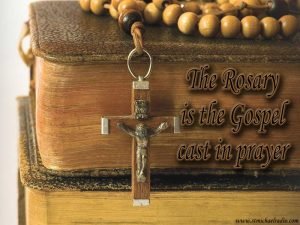
The most widely practiced form of Marian devotion is the Rosary, and it is worth being precise about what the Rosary is. The Rosary is a meditation on the mysteries of Christ’s life, organized into four sets: the Joyful Mysteries (the Annunciation, the Visitation, the Nativity, the Presentation, and the Finding in the Temple), the Luminous Mysteries (the Baptism of Jesus, the Wedding at Cana, the Proclamation of the Kingdom, the Transfiguration, and the Institution of the Eucharist), the Sorrowful Mysteries (the Agony in the Garden, the Scourging, the Crowning with Thorns, the Carrying of the Cross, and the Crucifixion), and the Glorious Mysteries (the Resurrection, the Ascension, Pentecost, the Assumption, and the Crowning of Mary).
The Hail Marys prayed on each decade are not the point of focus. Instead, they form a kind of rhythmic background while the mind meditates on a scene from Christ’s life. The prayer being offered is a request for Mary’s intercession, the same kind of request Catholics make when they ask any saint to pray for them. The focus of the prayer is Christ.
Mary as Intercessor
Catholic devotion to Mary operates within the same framework as devotion to the saints generally. Mary is not a mediator who stands between believers and God in the way Christ does. The Catechism is clear that Christ is the one mediator (paragraph 970). Mary’s role is intercessory: she brings the needs of the faithful to her son, as she did at the wedding at Cana when she told the servants, “Do whatever he tells you” (John 2:5). Catholic devotion to Mary is, ultimately, an orientation toward Christ, approached through the one who knew him first and most completely.
Hearing This Discussed on St. Michael Radio
Questions about Mary come up regularly across St. Michael Catholic Radio’s programming, particularly on Catholic radio on 94.9 FM Tulsa through Catholic Answers Live at 5 PM and through the morning Rosary at 8 AM, which gives listeners a daily encounter with the prayer itself. The full weekday schedule is at stmichaelsradio.com/programs for anyone who wants to follow the station’s full daily lineup.
Sources
- Catechism of the Catholic Church, paragraphs 484–511 and 963–975
- Ineffabilis Deus (1854)
- Munificentissimus Deus (1950)
- New Revised Standard Version of the Bible
- Program schedule sourced from stmichaelsradio.com/programs (captured June 2026)
12 Flashcard Q&As
Q1: Do Catholics worship Mary? A: No. Catholic teaching distinguishes clearly between worship (latria), which belongs to God alone, and veneration (dulia), which is honor given to holy persons. Mary receives a special form of veneration called hyperdulia, but this is not worship.
Q2: What are the four Marian dogmas? A: Mother of God (defined at the Council of Ephesus, 431 AD), Perpetual Virginity (ancient teaching), Immaculate Conception (defined by Pope Pius IX in 1854), and the Assumption (defined by Pope Pius XII in 1950).
Q3: What does Theotokos mean and why does it matter? A: Theotokos is Greek for “God-bearer” or “Mother of God.” It was defined at Ephesus in 431 AD primarily as a statement about Christ: that he is fully divine and human from the moment of his conception, not joined to divinity only later. The title protects Christology more than it elevates Mary.
Q4: What is the Immaculate Conception? A: The teaching that Mary was conceived without original sin, preserved from it by God’s grace in anticipation of Christ’s redemption. This refers to Mary’s own conception, not to the birth of Jesus, which is a separate teaching called the Virgin Birth.
Q5: What does the Assumption teach? A: That at the end of her earthly life, Mary was taken body and soul into heavenly glory. Defined by Pope Pius XII in 1950, this teaching affirms that Mary is now fully with God, body and soul, as a foretaste of the resurrection promised to all the faithful.
Q6: What does the Church say about the “brothers of Jesus” mentioned in the Gospels? A: Catholic tradition understands these as close relatives rather than children of Mary. The Greek word adelphos, translated as “brother,” was used in a culture where Aramaic was spoken and the same word served for brothers, half-brothers, and cousins. Church Fathers including Jerome held this interpretation from early centuries.
Q7: What is the Rosary? A: A prayer structured around meditation on the mysteries of Christ’s life. It is organized into four sets of mysteries covering events from the Annunciation through the glorification of Mary. The Hail Marys form a rhythmic background while the mind rests on scenes from Christ’s life.
Q8: Is the Rosary a prayer to Mary or a prayer about Christ? A: Both elements are present, but the primary focus is Christ. The mysteries meditated on are all events in Christ’s life. The Hail Mary is a request for Mary’s intercession, but the attention of the Rosary is directed toward her son.
Q9: What scriptural support does the Church draw on for its teachings about Mary? A: Luke 1:28 (Mary as “full of grace”), Luke 1:42–48 (Elizabeth’s greeting and Mary’s Magnificat), John 2:1–12 (the wedding at Cana), John 19:26–27 (Jesus entrusting Mary to the Beloved Disciple), and Acts 1:14 (Mary present with the disciples at Pentecost).
Q10: Is Mary a mediator between God and humanity? A: No. The Catechism (paragraph 970) is clear that Christ is the one mediator. Mary’s role is intercessory: she brings needs before her son, as at Cana. Her function is within Christ’s one mediation, not alongside it or in competition with it.
Q11: How old is devotion to Mary in Christian history? A: Very old. The Sub Tuum Praesidium, a prayer asking for Mary’s protection, survives on a papyrus from approximately the third century, making it one of the oldest known Christian prayers. The title Theotokos was in use before its formal definition at Ephesus in 431 AD.
Q12: Where can I hear Catholic teaching on Mary discussed on the radio in Tulsa? A: Catholic Answers Live airs weekdays at 5 PM on 94.9 FM Tulsa and regularly addresses questions about Mary. The morning Rosary with Bishop Robert Barron airs at 8 AM. The station is available to stream at stmichaelsradio.com/listen.